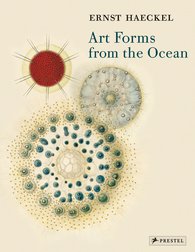
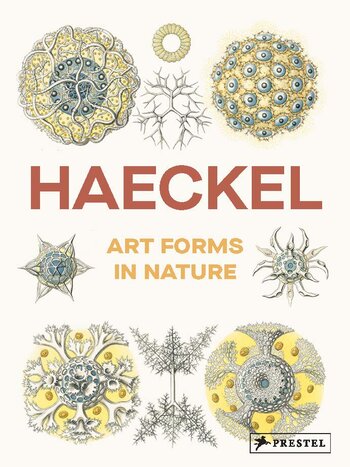
This exquisite volume features impeccably reproduced prints by the pioneering biologist and artist whose studies of nature helped shape the visual language of Art Nouveau.
Originally published in ten installments between 1899 and 1904, Ernst Haeckel’s 100 plates have become enduring icons of natural history and design. This edition brings together the original series in its entirety, preserving its fine lines, subtle tonal variations, and luminous color. Reproduced at full-page scale, Haeckel’s minute radiolarians, diatoms, and jellyfish appear alongside corals, orchids, moths, bats, hummingbirds, and antelopes, each rendered with extraordinary delicacy. Haeckel organized these organisms according to geometric and “constructive” principles, drawing attention to recurring symmetries, patterns, and structures across species and scales. The resulting compositions give visual expression to his monistic belief in the “unity of all living things,” presenting the immense variety of the natural world as part of an interconnected whole. Scientists have admired the images for their precision, while artists, architects, and designers embrace their organic geometries as a source of inspiration until this day. An illuminating essay by Olaf Breidbach examines the ideas behind the work and traces its cultural impact, including René Binet’s monumental entrance to the 1900 Paris Exposition. Together, the plates and incisive commentary bring Haeckel’s distinctive vision into focus, revealing why his art continues to captivate anyone drawn to the structures and beauty of life.
Biography
Olaf Breidbach
Olaf Breidbach studied art, philosophy, biology, and paleontology. Since 1995 he has occupied the chair in History of the Natural Sciences and been director of the Institute for the History of Medicine, Natural Sciences, and Technology at Friedrich-Schiller-Universität Jena, director of the Ernst-Haeckel-Haus Museum, leader of the department of Theoretical Biology at the Biological-Pharmaceutical faculty of the University of Jena, and a member of the Collaborative Research Center 482 "Ereignis Weimar-Jena. Kultur um 1800" (The Weimar-Jena Episode: Culture around 1800).
More books from the author